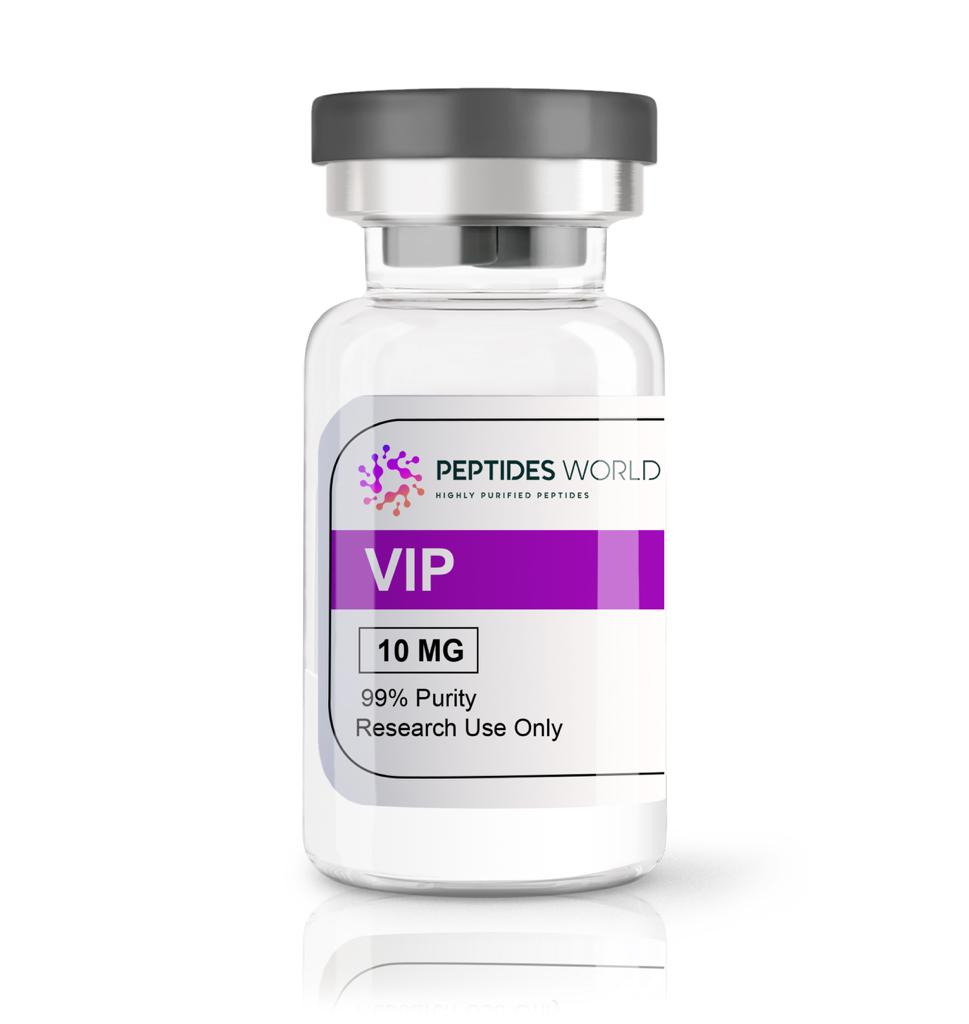
VIP
$198.00
VIP (Vasoactive Intestinal Peptide) is a powerful, naturally occurring neuropeptide known for its role in supporting cellular communication, immune balance, and overall physiological harmony. Widely studied for its anti-inflammatory and vasodilatory properties, VIP helps promote optimal blood flow, respiratory function, and gut health.
This premium-grade peptide is carefully formulated for purity and stability, making it an ideal choice for research and advanced peptide applications. VIP is particularly valued for its potential to regulate immune responses, support neurological signaling, and maintain healthy tissue function.
Key Benefits:
- Supports healthy immune system function
- Promotes improved circulation and vascular relaxation
- Aids in respiratory and gastrointestinal balance
- Known for anti-inflammatory and neuroprotective properties
Product Highlights:
- High-purity, research-grade formulation
- Precision synthesized for consistency
- Securely packaged for stability and longevity
VIP Peptide: A Complete Guide to the Research Compound Everyone’s Asking About Vasoactive Intestinal Peptide has quietly become one of the most searched-for research compounds in the peptide community over the last few years. Sold almost exclusively as a “research use only” material, it shows up constantly in forums, mold-illness and MCAS (mast cell activation syndrome) protocols, and functional-medicine discussions — usually shortened to its more searchable name: VIP Peptide
This guide walks through what the compound actually is, what scientists have studied it for, why it keeps coming up in gut-health conversations, how it needs to be handled once it arrives at your door, and — importantly — what to know about the increasingly crowded grey market where it’s sold alongside GLP-1 agonists like semaglutide and tirzepatide. None of this is medical advice, and nothing here should be read as instructions for self-administration. It’s meant to help you understand the landscape before you make any decisions, ideally with a licensed provider involved.
What Is VIP Peptide, Exactly? Vasoactive Intestinal Peptide (VIP) is a naturally occurring 28-amino-acid neuropeptide, first isolated from the small intestine in the early 1970s. It’s produced throughout the body — in the gut, the brain, the lungs, and immune cells — and it acts on a pair of receptors (VPAC1 and VPAC2) that are found almost everywhere. That wide distribution is exactly why researchers have poured so much attention into it: a single signaling molecule that touches digestion, immune regulation, smooth-muscle relaxation, and even circadian rhythm is a rare and interesting target.
Synthetic versions manufactured for laboratory research are typically labeled with some variation of “not for human consumption.” That labeling exists because the compound hasn’t gone through the clinical trial and approval process the FDA requires for a drug to be legally marketed for use in people. There is a prescription nasal spray formulation of a related molecule (Aviptadil) that has been studied clinically, but the lyophilized powder sold online as a research chemical is a different regulatory situation entirely, and buyers should treat it as such.
A Brief History of the Molecule The peptide was first characterized by two researchers, Sami Said and Viktor Mutt, who isolated it from porcine intestinal tissue in 1970 and published their findings in 1970 and 1972. What made it stand out from other gut hormones being discovered around the same time was its unusually broad distribution — instead of being confined to a single organ system, VIP-producing neurons and receptors turned up in the brain, lungs, pancreas, thyroid, adrenal glands, and reproductive tissue, in addition to the digestive tract where it was originally found.
That broad distribution is also what has made the molecule so hard to pin down clinically. A hormone that does one specific job in one specific tissue is comparatively easy to develop into a targeted drug. A signaling peptide that touches a dozen different systems tends to produce a correspondingly complicated pharmacology — which helps explain why, more than fifty years after its discovery, there’s still only one narrowly approved clinical formulation (the inhaled version studied for pulmonary arterial hypertension) rather than a broad family of approved VIP-based medications.
Academic interest never went away, though. PubMed lists thousands of papers referencing the peptide, spanning immunology, gastroenterology, neuroscience, and endocrinology, and it remains an active area of basic-science research at universities and hospital-affiliated labs. The gap between that steady academic interest and the sudden explosion of consumer-facing retail sales over the past three or four years is really the story of the broader research-peptide market catching up with — and monetizing — decades-old science.
What Is VIP Peptide Used For in Research? Within laboratory and preclinical settings, VIP has been studied across several distinct areas: Gastrointestinal motility and secretion. VIP is one of the primary neurotransmitters controlling relaxation of smooth muscle in the gut, and it influences fluid and electrolyte secretion in the intestinal lining. This is the mechanistic basis for most of the gut-health interest described later in this article.
Immune modulation. VIP receptors sit on multiple types of immune cells, and animal studies have looked at the peptide’s role in dampening inflammatory cytokine release. This is the thread that connects it to interest from people managing mast cell activation syndrome or chronic inflammatory response syndrome (CIRS), often associated with water-damaged building exposure.
Neuroprotection and circadian signaling. VIP is heavily expressed in the suprachiasmatic nucleus, the brain’s master clock, where it helps synchronize neurons to a shared daily rhythm. Some preclinical work has also explored neuroprotective effects in models of neurodegeneration.
Pulmonary and vascular research. Because of VIP’s vasodilatory properties, there has been academic interest in pulmonary hypertension and related vascular conditions — this is the line of research that produced Aviptadil.
It’s worth being precise here: “studied for” is not the same as “proven effective for” or “approved to treat.” Most of what’s circulating online about this compound comes from small studies, animal models, or practitioner anecdote rather than large, controlled human trials. Anyone encountering strong claims about guaranteed outcomes should treat that as a red flag rather than reassurance.
VIP Peptide Benefits: What the Evidence Actually Supports
When people search for benefits, they’re usually looking for a confident list of outcomes. The honest answer is more measured. Based on the mechanisms above, the areas researchers have found most promising include:
- Modulating gut motility signaling in preclinical models, relevant to conditions involving dysregulated intestinal contraction
- Reducing markers of inflammatory signaling in some cell and animal studies related to mast cell and cytokine activity
- Supporting circadian alignment in neuroscience research on the suprachiasmatic nucleus
- Vasodilatory effects relevant to pulmonary vascular research
None of these translate directly into a guarantee of what an individual would experience, and human clinical data for most of these applications remains limited. Anyone considering this compound for a specific health condition should be talking to a physician familiar with peptide therapies, not relying on marketing copy or forum testimonials — including, frankly, this article.
VIP Peptide and Gut Health: Why the Two Keep Getting Linked Together
Of all the applications, gut health is where VIP peptide shows up most often in consumer conversation, and there’s a real mechanistic reason for that. The enteric nervous system — sometimes called the “second brain” — relies heavily on VIP-releasing neurons to coordinate the rhythmic contraction and relaxation that moves food through the digestive tract. When that signaling is disrupted, it’s been associated in research settings with motility issues.
There’s also a secondary connection through the mast cell and inflammation angle. A subset of people dealing with chronic gut symptoms are also dealing with mast cell activation, and because VIP has documented effects on mast cell behavior, some functional-medicine practitioners have folded it into broader protocols alongside diet changes, antihistamines, and other interventions. It’s important to understand this is an emerging, practitioner-driven area rather than an established standard of care, and results reported anecdotally haven’t been validated at the scale that would let anyone call this a proven gut-health treatment.
How to Store VIP Peptide Correctly (General Handling Principles)
Whatever the intended research application, peptides like this are fragile molecules, and how they’re stored significantly affects whether the material remains chemically intact. These are general handling principles that apply to lyophilized peptides broadly, not specific instructions for use:
- Before reconstitution: the lyophilized (freeze-dried) powder is comparatively stable and is typically kept refrigerated (around 2–8°C) or frozen, away from light, until it’s going to be reconstituted with a diluent.
- After reconstitution: once any peptide is mixed with liquid, it becomes far more vulnerable to degradation from heat, light, and repeated temperature cycling. Reconstituted peptides are generally kept refrigerated and used within a short window recommended by the manufacturer’s documentation — leaving them at room temperature for extended periods, or refreezing and re-thawing repeatedly, accelerates breakdown.
- Light exposure: many peptides are light-sensitive, which is why they typically ship in amber vials or opaque packaging. Keeping vials away from direct sunlight preserves potency.
- Avoid shaking: vigorous agitation can denature peptide structure; gentle swirling is the standard recommendation for mixing.
- Documentation matters: because sourcing in this space varies so much in quality, the certificate of analysis (COA) and manufacturer storage guidance that comes with a given batch should be treated as the primary reference, since stability can vary by formulation.
If a supplier can’t or won’t provide clear storage and handling documentation, that’s a meaningful signal about the overall quality of what you’re buying — which brings us to the grey market question.
The Grey Market Problem: VIP Peptide, GLP-1s, and the Research-Chemical Industry
It’s impossible to talk honestly about this compound without addressing the ecosystem it’s sold in. Over the past several years, the same “research use only” marketplace that sells VIP has exploded in size largely because of consumer demand for GLP-1 receptor agonists — semaglutide, tirzepatide, and retatrutide — driven by the popularity of prescription weight-loss drugs like Ozempic, Wegovy, and Mounjaro. That demand created a shadow market of compounding pharmacies, overseas manufacturers, and online “research chemical” vendors, and peptides like VIP have effectively hitched a ride on that same supply chain and customer base.
A few things are worth understanding about this market:
Quality control is inconsistent. Because these products aren’t regulated as pharmaceuticals, purity and concentration can vary dramatically between batches and vendors. Independent testing efforts — including third-party lab analyses that have circulated publicly — have repeatedly found products from grey-market sellers that were underdosed, overdosed, contaminated, or in some cases contained none of the labeled compound at all.
Legal status is murky and shifting. The FDA and state pharmacy boards have taken increasing enforcement action against compounders and sellers marketing peptides like semaglutide for human use outside of a valid prescription framework, and “research use only” labeling doesn’t provide the legal cover some sellers imply it does when the product is clearly being marketed and used for personal consumption.
There’s no clinical oversight. A prescription pathway involves a physician evaluating your health history, monitoring for interactions and side effects, and adjusting a documented treatment plan. Grey-market purchases skip all of that, which shifts the entire risk burden onto the buyer.
Pricing that looks “too good” often is. A price point dramatically below what a legitimate compounding pharmacy charges is frequently a signal of cut corners somewhere in the manufacturing chain.
None of this means every research-chemical vendor is acting in bad faith, but the burden of verification — third-party COAs, transparent manufacturing sourcing, batch testing — sits entirely with the buyer in this space, and that’s a meaningfully different situation than buying an FDA-approved medication from a licensed pharmacy.
How Regulators Are Responding
The compounding and research-chemical peptide market hasn’t gone unnoticed by regulators, and the trajectory is worth understanding before making any purchasing decision.
In the United States, compounding pharmacies are allowed to prepare customized medications for individual patients under a valid prescription, governed by state pharmacy boards and, for larger “outsourcing facilities,” by FDA oversight under Section 503B of the Food, Drug, and Cosmetic Act. That framework exists for legitimate clinical needs — patients with allergies to inactive ingredients in a commercial drug, for instance, or shortages of an approved medication. It was never designed to be a workaround for selling unapproved compounds directly to consumers without a prescribing relationship, and enforcement activity in recent years has increasingly targeted that gap.
The FDA has issued warning letters to multiple compounders and online sellers over marketing practices for GLP-1 medications and other peptides, and several state pharmacy boards have opened their own investigations into online telehealth operations selling compounded versions of drugs that also exist in FDA-approved form. Some peptides have also been added to, or considered for, the FDA’s “difficult to compound” list, which restricts pharmacies from making bulk versions of them at all outside very specific circumstances.
VIP occupies a slightly different lane than GLP-1 drugs because there isn’t a widely prescribed branded competitor driving the same level of enforcement attention — but that doesn’t mean it’s operating in a cleared, sanctioned space. It means the enforcement spotlight simply hasn’t swung there as forcefully yet. Given how quickly this regulatory environment has shifted for adjacent compounds, treating “research use only” labeling as a stable, permanent legal status would be a mistake. Anyone monitoring this space should expect the rules to keep tightening rather than loosening.
Questions Worth Asking Before You Buy Anything in This Category
Independent of any specific compound, there’s a short list of questions that tends to separate a more careful vendor from a riskier one, and it’s worth running through them deliberately rather than relying on a polished website as a proxy for legitimacy:
- Does the vendor provide a batch-specific certificate of analysis, or a generic one that’s reused across every listing? A real COA references a specific lot number that matches what’s printed on your vial.
- Is the testing done by an independent third-party lab, or an in-house lab controlled by the seller? Independent verification carries much more weight.
- Can you find the manufacturer’s actual name and location, or does the trail stop at a storefront with no manufacturing information?
- Does customer support engage substantively with sourcing and purity questions, or deflect with vague reassurances?
- Is the price dramatically lower than comparable listings elsewhere? In a market with real manufacturing and testing costs, prices that are far outside the normal range are a signal worth taking seriously.
None of these questions guarantee safety on their own, but a vendor who fails several of them at once is a much higher-risk purchase than one who’s transparent across the board.
Frequently Asked Questions
Is VIP peptide the same thing as a GLP-1 drug? No. VIP and GLP-1 agonists work through completely different receptor systems and were studied for different original purposes. They’re often sold by the same category of vendors, which is why people encounter them together, but mechanistically they aren’t related.
Is VIP peptide legal to buy? It’s generally sold under research-use-only labeling, which exists in a legal grey zone rather than being clearly authorized for personal use. Regulatory scrutiny of the broader peptide market has increased, so the landscape is shifting and worth checking on directly through current FDA and state pharmacy board guidance rather than vendor marketing claims.
How is VIP peptide typically supplied? As a lyophilized (freeze-dried) powder in a vial, which requires reconstitution with a sterile diluent before it can be used in any research setting.
What is VIP peptide used for by researchers? Primarily gastrointestinal motility studies, immune and mast-cell signaling research, circadian rhythm neuroscience, and vascular/pulmonary research, as outlined above.
Does VIP peptide have side effects? Because comprehensive human clinical trials are limited, a full, well-characterized side-effect profile doesn’t exist in the way it would for an approved drug. Reported effects in limited studies have included flushing, changes in blood pressure, and gastrointestinal symptoms, related to its vasodilatory and gut-motility mechanisms. This is exactly the kind of unknown that makes physician oversight important rather than optional.
Can I combine VIP peptide with other peptides or medications? This is a question for a licensed provider familiar with your full medication list and health history, not something that should be decided from a forum thread or vendor FAQ page.
How do I evaluate whether a vendor is trustworthy? Look for a third-party certificate of analysis for the specific batch you’re purchasing (not a generic one), transparent manufacturing information, and a willingness to answer detailed sourcing questions. Vendors who are cagey about any of this warrant extra skepticism.
What People in the Research and Wellness Community Are Discussing
Rather than presenting invented testimonials, it’s more useful to summarize the themes that come up repeatedly in practitioner and community discussion around VIP peptide:
- People with CIRS or MCAS-adjacent diagnoses report that VIP is one of several compounds discussed within functional and integrative medicine protocols, usually alongside binders, antihistamines, and environmental remediation — not as a standalone fix.
- Discussion threads frequently center on sourcing anxiety: how to identify a lab with verifiable third-party testing versus one that isn’t.
- Storage and handling questions — particularly around reconstitution stability and shipping in hot weather — are among the most common practical questions raised.
These are patterns in public discussion, not verified outcomes, and they shouldn’t be read as endorsements of efficacy or safety.
The Bottom Line
VIP peptide sits at an interesting intersection: legitimate, published research into a naturally occurring neuropeptide with real biological significance, and a consumer marketplace that has grown largely on the coattails of GLP-1 demand, with far less regulatory oversight than most people buying it probably realize. The mechanistic story — gut motility, immune modulation, circadian signaling — is genuinely interesting and grounded in real science. The commercial story around how it’s sold, stored, and used by non-clinicians is considerably murkier.
Anyone seriously considering this compound, for gut health or anything else, is best served by bringing it to a licensed physician who can evaluate it in the context of an actual medical history, rather than piecing together a protocol from vendor websites and community forums. Sourcing matters enormously in a market with this little oversight, and the questions worth asking — third-party testing, manufacturing transparency, storage documentation — apply whether the product in question is VIP, a GLP-1 analog, or any other research peptide currently circulating in this fast-growing, loosely regulated space.
| Dose | 10mg*10vials |
|---|
Be the first to review “VIP”
Related products
HEALING/REPAIR
HEALING/REPAIR
HEALING/REPAIR
Reviews
There are no reviews yet.