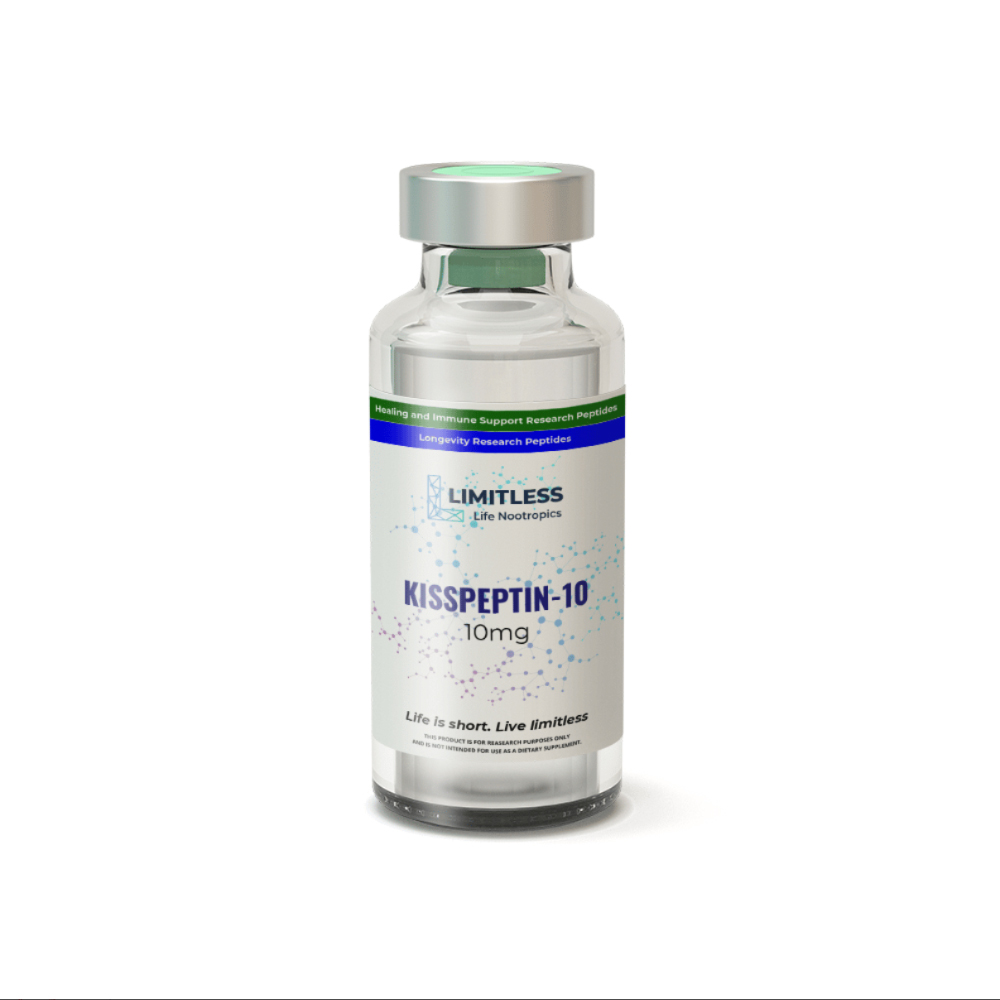
KissPeptin-10
Price range: $77.00 through $121.00
Kisspeptin-10 is a bioactive research peptide derived from the KISS1 protein, widely studied for its role in regulating the hypothalamic-pituitary-gonadal (HPG) axis. It is a key signaling molecule involved in stimulating gonadotropin-releasing hormone (GnRH) activity, making it a valuable compound in endocrine and reproductive biology research.
This high-purity peptide is intended strictly for laboratory and scientific use, offering researchers a reliable tool for investigating hormone signaling pathways, fertility mechanisms, and neuroendocrine function.
Key Features:
- High-purity research-grade peptide
- 10-amino acid active fragment (KP-10)
- Commonly studied in reproductive and endocrine research
- Ideal for laboratory and in-vitro studies
- Strictly for research purposes only
Kisspeptin-10 continues to be a critical focus in scientific studies exploring hormonal regulation and cellular communication within the reproductive system.
Kisspeptin-10 — Research-Grade Peptide for Laboratory Use
Choosing a Kisspeptin-10 Supplier: A Guide for Research Buyers
Kisspeptin-10 supplier Kisspeptin-10 is the shortest bioactive fragment of kisspeptin, a neuropeptide sitting directly upstream of GnRH (gonadotropin-releasing hormone) in the hypothalamic-pituitary-gonadal (HPG) axis — the system governing puberty, reproductive function, and sex hormone regulation. Researchers evaluating a Kisspeptin-10 supplier are typically working in reproductive endocrinology, fertility, or neuroendocrine research, and sourcing standards deserve particular attention here given how directly this compound interacts with hormonal signaling.
This is written for a research-buyer audience — not guidance for human self-administration. Kisspeptin-10 is not approved by the FDA or any comparable body for any human use. It carries a different risk category than several other research peptides, precisely because it acts on the reproductive hormone axis itself.
What Is Kisspeptin-10?
Kisspeptin-10 is the ten-amino-acid C-terminal fragment of kisspeptin that retains full activity at the kisspeptin receptor (KISS1R/GPR54), found on GnRH-producing neurons. Kisspeptin signaling is now understood as a primary trigger for GnRH release — a master regulator at the top of the reproductive hormone cascade.
Research areas in the literature:
- Puberty onset — kisspeptin signaling is established as essential for puberty initiation; KISS1R mutations are linked to delayed or absent puberty.
- Fertility/IVF research — legitimate academic studies have examined kisspeptin for inducing ovulation and studying LH/FSH pulsatility.
- Libido/arousal research — Imperial College London studies examined effects on brain activity related to sexual and emotional processing; this is the work most often (loosely) cited by consumer-facing vendors.
- HPG axis studies — relevant to precocious puberty and hormone-sensitive cancer research.
This compound has genuinely stronger clinical research backing than several others in this space — but clinically-monitored trial use is not the same as safe unsupervised use, and that gap matters more here than for peripheral-mechanism peptides.
Why Sourcing Matters More for a Hormone-Axis Compound
- CoA with batch-specific HPLC/mass spec data — purity and identity verification matter more when a degraded or misidentified product could interact unpredictably with the HPG axis.
- Mass spec identity confirmation — partial degradation products could retain some receptor activity while behaving unpredictably.
- Sterility/endotoxin testing — standard baseline for any research application.
- Storage/stability documentation — frozen, moisture/light-protected, clearly specified.
- Reconstitution guidance strictly for research protocols — legitimate suppliers reference molarity for defined experiments, not “libido dosing” schedules. Any personal-use dosing content signals unmonitored hormonal intervention marketing.
Evaluating a Trusted Kisspeptin-10 Vendor
A trusted Kisspeptin-10 vendor should: provide batch-specific CoA/mass spec before purchase; describe clinical trial evidence accurately rather than implying it validates home use; operate under a verifiable quality system; label consistently as RUO throughout (not undercut by libido dosing content); and provide proper invoicing/SDS for institutional buyers.
Kisspeptin-10 for Sale: The Reproductive-Hormone Risk
This deserves its own emphasis. Kisspeptin-10 acts at the control point of the reproductive hormone cascade, not a downstream pathway. Any Kisspeptin-10 for sale listing aimed at unsupervised use should be understood against:
- Unpredictable feedback effects on tightly regulated LH/FSH pulsatility
- Population-dependent effects (sex, age, hormonal status) that clinical trials screen for and vendors cannot
- No monitoring — published research involved blood draws before/during/after; a grey-market purchase has none of that
- No long-term data on repeated unsupervised dosing
A Note on Grey-Market Peptides and GLP-1 Compounds
Kisspeptin-10 is mechanistically unrelated to GLP-1/amylin agonists but is often sold on the same marketplaces as semaglutide, tirzepatide, and cagrilintide under RUO labeling. Those carry documented risks: unverified sterility/purity, research-titration dosing mismatched to human pharmacokinetics (linked to GI illness and overdose from concentration errors), no prescriber screening for contraindications, and active FDA warnings on compounded/grey-market GLP-1 products. A vendor pairing a hormone-axis compound like this with consumer-marketed GLP-1 products signals a business built around bypassing medical oversight generally.
FAQ (condensed)
Legal to buy? Generally yes when labeled/marketed strictly for research use; marketing practices matter, and some regulators scrutinize hormone-axis peptides more closely.
Same as the Imperial College libido studies? Related compound, but those used clinically monitored IV administration — not comparable to unsupervised use.
Purity standard? ≥98%, HPLC + mass spec confirmed.
Storage? Frozen, lyophilized, light/moisture protected; shorter window once reconstituted.
Safe as a libido supplement? No evidence base for unsupervised use; the hormone-axis risks above apply directly.
Red flags? Libido/fertility marketing, personal dosing schedules, testimonials, clinical-data-as-safety-proof framing, GLP-1 bundling.
Summary
Evaluate a Kisspeptin-10 supplier on documentation rigor and honesty about what separates this compound from most others: direct action on the reproductive hormone axis, with legitimate research conducted only under monitoring no retail purchase replicates.
| Dose | 5mg*10vials, 10mg*10vials |
|---|
Be the first to review “KissPeptin-10”
Related products
SEXUAL HEALTH/FERTILITY
Reviews
There are no reviews yet.