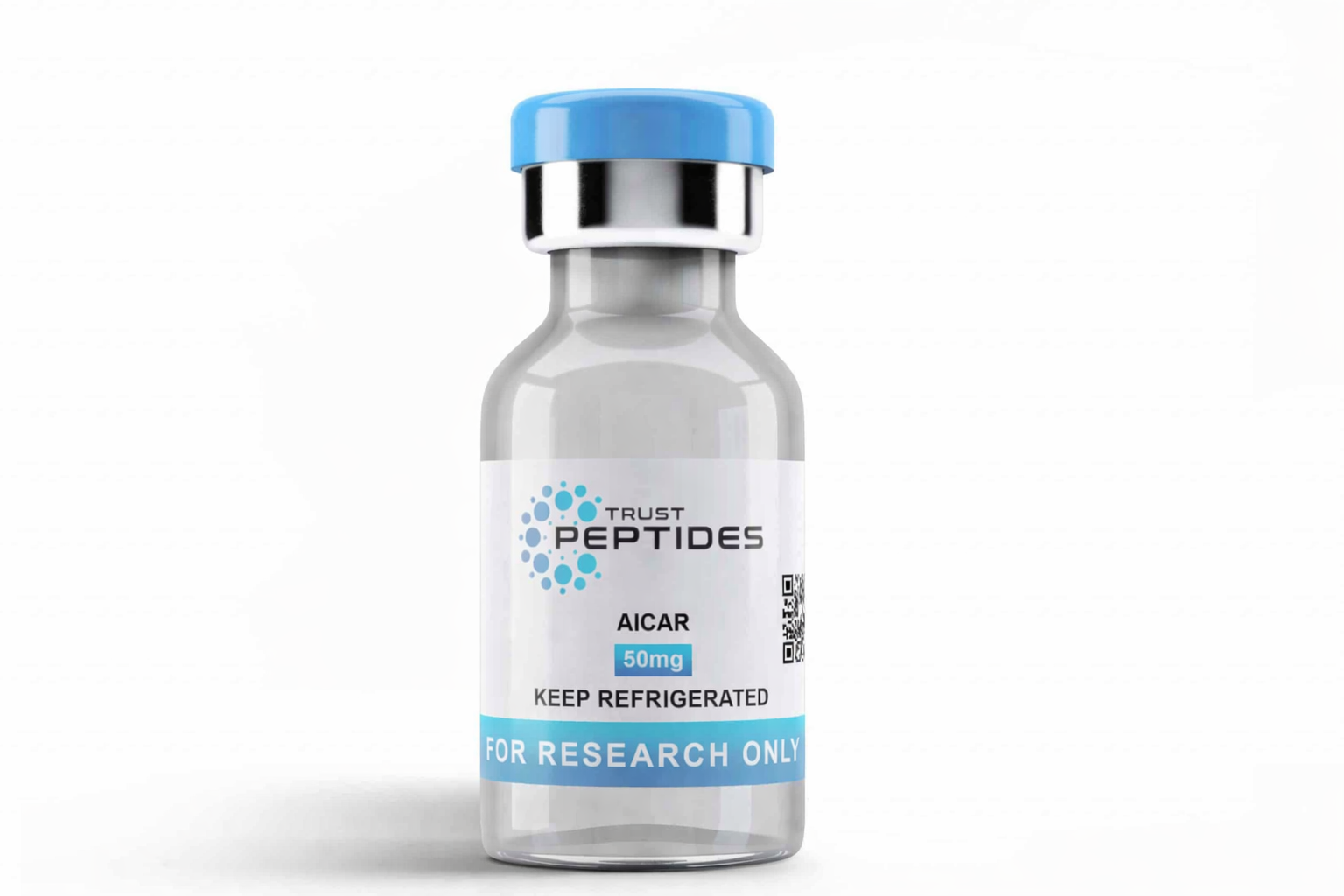
AICAR
Price range: $72.00 through $135.00
AICAR is a research-grade peptide known for its role in supporting cellular energy regulation and metabolic signaling pathways. Often studied for its ability to activate AMP-activated protein kinase (AMPK), AICAR is widely explored in metabolic research, endurance performance studies, and cellular energy optimization.
This high-purity compound is designed for laboratory and scientific applications, making it a valuable tool for researchers investigating glucose uptake, fat metabolism, and mitochondrial efficiency. AICAR continues to gain attention in advanced biochemical studies focused on energy balance and cellular performance mechanisms.
Key Highlights:
- Research-grade purity for laboratory use
- Commonly studied for AMPK pathway activation
- Investigated for metabolic and energy regulation research
- Supports advanced cellular and mitochondrial studies
AICAR — Research-Grade Compound for Laboratory Use
AICAR: Buy Online for Legitimate Research Purposes
AICAR (5-Aminoimidazole-4-carboxamide ribonucleotide) is a nucleotide analog widely studied in cell biology and metabolic research for its role in activating AMP-activated protein kinase (AMPK). Laboratories and academic researchers searching for AICAR buy online listings are typically looking for a compound with verified purity, proper cold-chain handling, and documentation suitable for controlled experimental use — not a consumer supplement.
This page is written for that audience: principal investigators, lab technicians, and institutional buyers evaluating research suppliers. It is not intended as guidance for human self-administration, and nothing here should be interpreted as dosing advice for personal use. AICAR is not approved by the FDA or any comparable regulatory body for human consumption, treatment, or performance enhancement.
What Is AICAR?
AICAR is an intermediate in the purine biosynthesis pathway and a well-characterized pharmacological activator of AMPK, an enzyme central to cellular energy regulation. Because AMPK sits at the intersection of glucose uptake, fatty acid oxidation, and mitochondrial biogenesis, AICAR has been a standard tool compound in metabolic research for over two decades.
Key research applications include:
- AMPK pathway studies — AICAR is frequently used in vitro to activate AMPK in cultured cells, allowing researchers to isolate downstream signaling effects.
- Exercise physiology and skeletal muscle research — a 2008 study published in Cell (Narkar et al.) examined AICAR’s effects on mitochondrial gene expression in sedentary mice, contributing to its reputation as an “exercise-mimetic” compound in the scientific literature.
- Cardioprotection and ischemia models — AICAR has been studied for its effects on cellular energy status during oxygen-restricted conditions.
- Cancer metabolism research — some studies have investigated AMPK activation’s role in tumor cell energy sensing.
None of these applications constitute approved medical uses. They describe the existing body of in vitro and animal-model literature, which is the context in which legitimate suppliers should be marketing this compound.
Why “Sterile” and Purity Documentation Matter
When researchers look to buy AICAR powder for sale, the two variables that actually determine whether a compound is usable in a real experimental protocol are purity and sterility — not price.
- Certificate of Analysis (CoA): A trustworthy supplier provides batch-specific HPLC or mass spectrometry data confirming purity (typically ≥98% for research-grade material).
- Endotoxin testing: For any application involving cell culture, endotoxin contamination can invalidate results. Sterile-filtered, endotoxin-tested lots are essential for cell-based assays.
- Cold-chain shipping: AICAR degrades under improper storage conditions. Suppliers should ship with appropriate temperature control and provide storage guidance (typically -20°C, protected from moisture).
- Solvent and reconstitution data: Legitimate research suppliers provide solubility information (AICAR is water-soluble) rather than dosing instructions, since research use means precise molarity in a buffer or media — not a serving size.
If a listing for AICAR peptide for sale — note that AICAR is technically a nucleotide analog, not a peptide, and any supplier using that terminology interchangeably is a signal worth scrutinizing — doesn’t offer any of the above documentation, that’s a meaningful red flag regardless of price.
Evaluating an AICAR Supplier
Because AICAR is unregulated as a consumer product but is manufactured and sold at genuinely variable quality levels, due diligence matters more here than with most lab reagents. Questions worth asking any AICAR supplier before ordering:
- Can they provide a CoA for the specific batch being shipped, not a generic one from a different lot?
- Is the listed purity independently verifiable, or only self-reported?
- Does the supplier operate under any quality system (ISO certification, GMP-adjacent practices for research chemicals, etc.)?
- Is the product explicitly labeled “for laboratory research use only, not for human consumption”? Suppliers who omit this, or who market toward personal use with dosing charts and testimonials, are operating in a regulatory grey area at best.
- Do they ship with appropriate documentation for institutional procurement (invoices suitable for grant reporting, MSDS/SDS sheets, import/export compliance where relevant)?
Reputable suppliers welcome these questions. Ones that dodge them, or that lean heavily on urgency-driven sales language, are worth avoiding — both for data integrity reasons and because that pattern often correlates with mislabeled or adulterated product.
A Note on Grey-Market Peptides and GLP-1 Compounds
AICAR is frequently sold alongside other research compounds, including GLP-1 receptor agonists like semaglutide and tirzepatide, marketed under research-use-only labeling. It’s worth being direct about this category, because the risk profile is different and more serious than with a tool compound like AICAR.
GLP-1 medications are approved pharmaceuticals when manufactured, dosed, and prescribed through legitimate medical channels — but “grey market” versions sold as research chemicals or compounded outside that oversight carry real risks:
- No verified sterility or purity in many cases, despite RUO labeling designed to bypass regulatory scrutiny.
- Dosing based on peptide products intended for research titration, not calibrated for human pharmacokinetics, which has been linked to adverse events including severe gastrointestinal effects and, in some reported cases, incorrect concentration leading to overdose.
- No prescriber oversight to screen for contraindications (personal or family history of certain thyroid cancers, pancreatitis risk, etc.) that legitimate GLP-1 prescribing protocols are built around.
- Regulatory bodies including the FDA have issued specific warnings about compounded and grey-market GLP-1 products, particularly during periods of branded-drug shortage when grey-market supply expanded.
If your research program genuinely involves GLP-1 compounds, the same supplier-vetting standard applies — CoA, endotoxin testing, batch-specific documentation — and any use in animal models should go through your institution’s IACUC protocols. If the interest is personal weight management or metabolic health rather than laboratory research, that conversation belongs with a licensed prescriber, not a peptide vendor.
Frequently Asked Questions
Is it legal to buy AICAR online? In most jurisdictions, AICAR can be legally purchased and sold when explicitly labeled and marketed for laboratory research use, not human consumption. Regulations vary by country and by how the product is marketed — suppliers who market toward personal use rather than research use may be operating outside those protections.
What’s the difference between “research-grade” and “pharmaceutical-grade” AICAR? Pharmaceutical-grade compounds are manufactured under GMP conditions with full regulatory oversight and are approved for a specific human use. AICAR has no pharmaceutical-grade designation because it is not an approved drug anywhere. “Research-grade” simply means it meets a purity standard suitable for lab experiments — it says nothing about safety for human use.
Why do purity percentages vary between suppliers? Manufacturing processes differ, and not all suppliers independently verify their stated purity. A listing claiming 99% purity with no CoA is not more trustworthy than one claiming 98% with third-party verification — it may be less trustworthy.
Does AICAR require refrigeration during shipping? Yes, in most cases. AICAR is generally stable short-term at room temperature but is recommended to be stored frozen (-20°C) for longer-term stability. Reputable suppliers ship with cold packs and provide storage guidance on the CoA or packing slip.
Can AICAR be used in cell culture without additional processing? It typically needs to be reconstituted in an appropriate solvent (commonly water or a buffer matched to the cell culture system) at a defined molarity for the specific assay. Reconstitution protocols depend entirely on the experimental design, which is why legitimate suppliers don’t provide one-size-fits-all instructions.
Is AICAR the same as SR9009 or other AMPK-related research compounds? No. AICAR, SR9009, and other AMPK/metabolic pathway compounds have distinct mechanisms and should not be treated as interchangeable, despite sometimes being marketed together as a “stack.”
How should institutional buyers document AICAR purchases for grant compliance? Request itemized invoices, the batch-specific CoA, and — where applicable — an SDS. Most granting bodies require reagent purchases to be traceable to a specific vendor, batch, and purity specification, which underscores why documentation quality should be a primary factor in supplier selection, not an afterthought.
What red flags suggest a supplier isn’t legitimate? Marketing language aimed at personal dosing rather than lab use, absence of batch-specific documentation, testimonial-driven sales pages, and pricing significantly below the market range for verified research-grade material are the most common warning signs.
Summary
For labs and institutional buyers evaluating where to source this compound, the decision should rest on documentation and supplier transparency — not marketing claims. When researchers search for AICAR buy online, what actually matters is a verifiable CoA, endotoxin testing where relevant, proper cold-chain shipping, and a supplier willing to answer direct questions about manufacturing and quality control. The same standard applies whether you’re sourcing AICAR specifically or evaluating any AICAR supplier offering adjacent research compounds, including grey-market GLP-1 products, where the stakes for improper sourcing are considerably higher.
| Dose | 50mg*10vials, 100mg*10vials |
|---|
Be the first to review “AICAR”
Related products
WEIGHT LOSS
WEIGHT LOSS
WEIGHT LOSS
WEIGHT LOSS
WEIGHT LOSS
Reviews
There are no reviews yet.